Drying knitwear without losing its shape
Plan where a jumper will dry before you wash it, especially when it becomes heavy with water.
The awkward part of washing knitwear is often not the wash itself but the hours afterwards. A wet jumper can be much heavier than the dry garment, and the way you support it affects its shape. Prepare a suitable drying space before beginning, rather than discovering afterwards that the only spare hanger is a thin wire one.
Read the care label first. Some garments permit machine drying under specific conditions, while others require flat drying or professional care. Instructions for one wool jumper should not be transferred automatically to another knit made from a different fibre, construction or finish.
Support the wet garment
Woolmark recommends flat drying wool knitwear unless its label allows tumble drying. It also cautions against hanging wet knitwear under its own weight and against direct heat. Use the garment's instructions to decide how to remove excess water; avoid aggressive twisting or wringing that distorts the fabric.
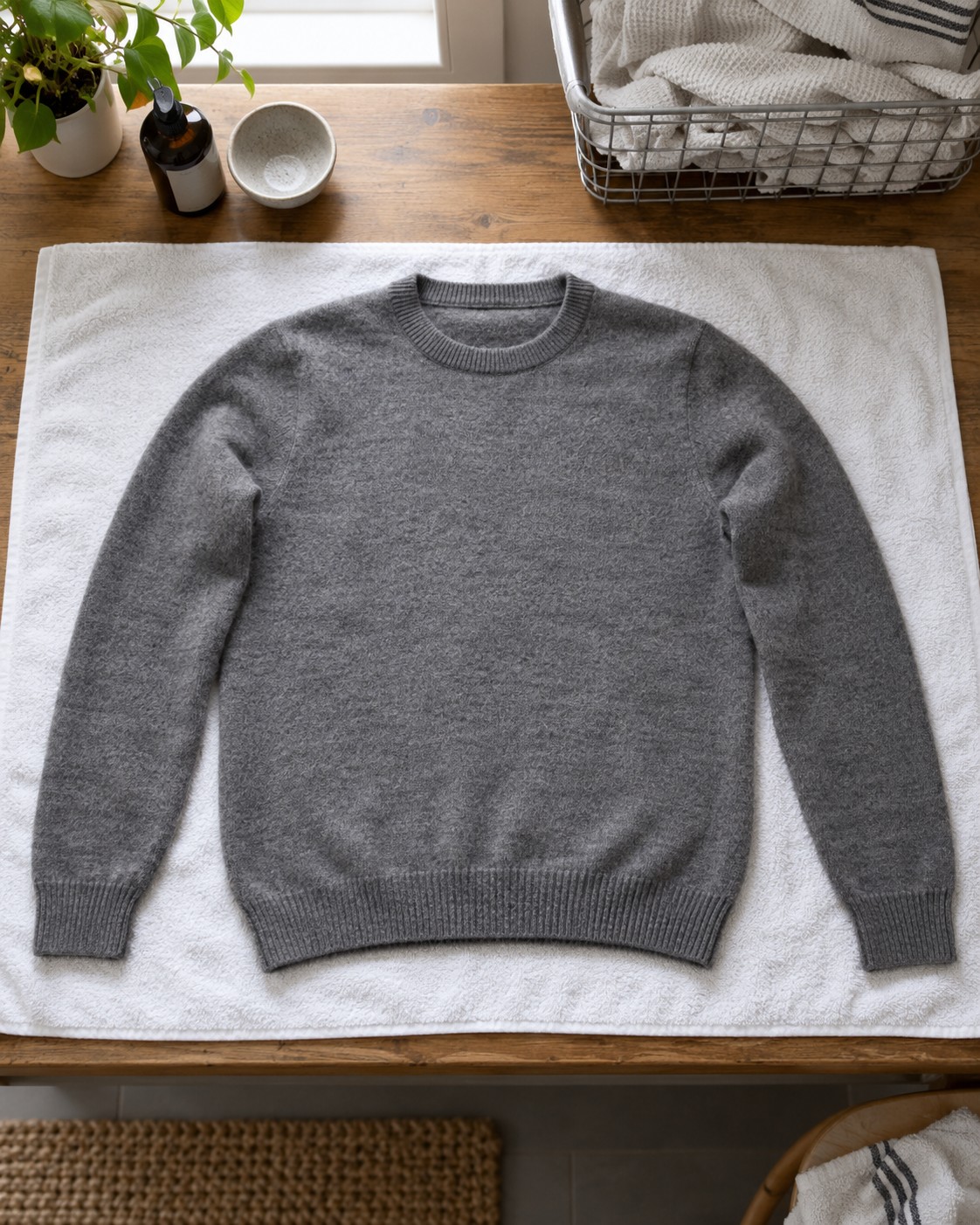
Prepare a clean, pale, lint-free towel or a suitable drying mesh. Arrange the jumper in its natural shape, with sleeves supported and seams lying comfortably. Smooth obvious folds with gentle handling. Do not pull the body wider or longer to match an imagined ideal size.
Make room around the garment so it can dry. A thick jumper folded into several damp layers takes longer than one laid out with care. If the supporting towel becomes saturated, change it without stretching the knit. Check the underside as well as the surface before deciding it is dry.
Avoid the tempting shortcuts
A radiator may seem convenient, but concentrated heat is not a substitute for the recommended drying method. The same applies to hanging a wet jumper in strong sun or putting it into a dryer because you need it that evening. Choose another garment to wear instead of forcing this one through an unsuitable process.
If the knit appears distorted, do not repeatedly stretch it while wet in an attempt to rescue it. Consult the maker or a textile-care professional for advice appropriate to the garment. Some changes can be difficult to reverse, and online reshaping tricks are not universal repairs.
Once the jumper is fully dry, fold it so its weight is supported. Check that cuffs and underarm areas are dry too; they can retain moisture after the body feels ready. Give it space in storage rather than compressing it immediately beneath a heavy pile.
The simplest improvement is scheduling. Wash knitwear when you can give it the drying time and surface it needs. A small amount of planning protects the shape more reliably than a complicated rescue routine after a hurried wash.